
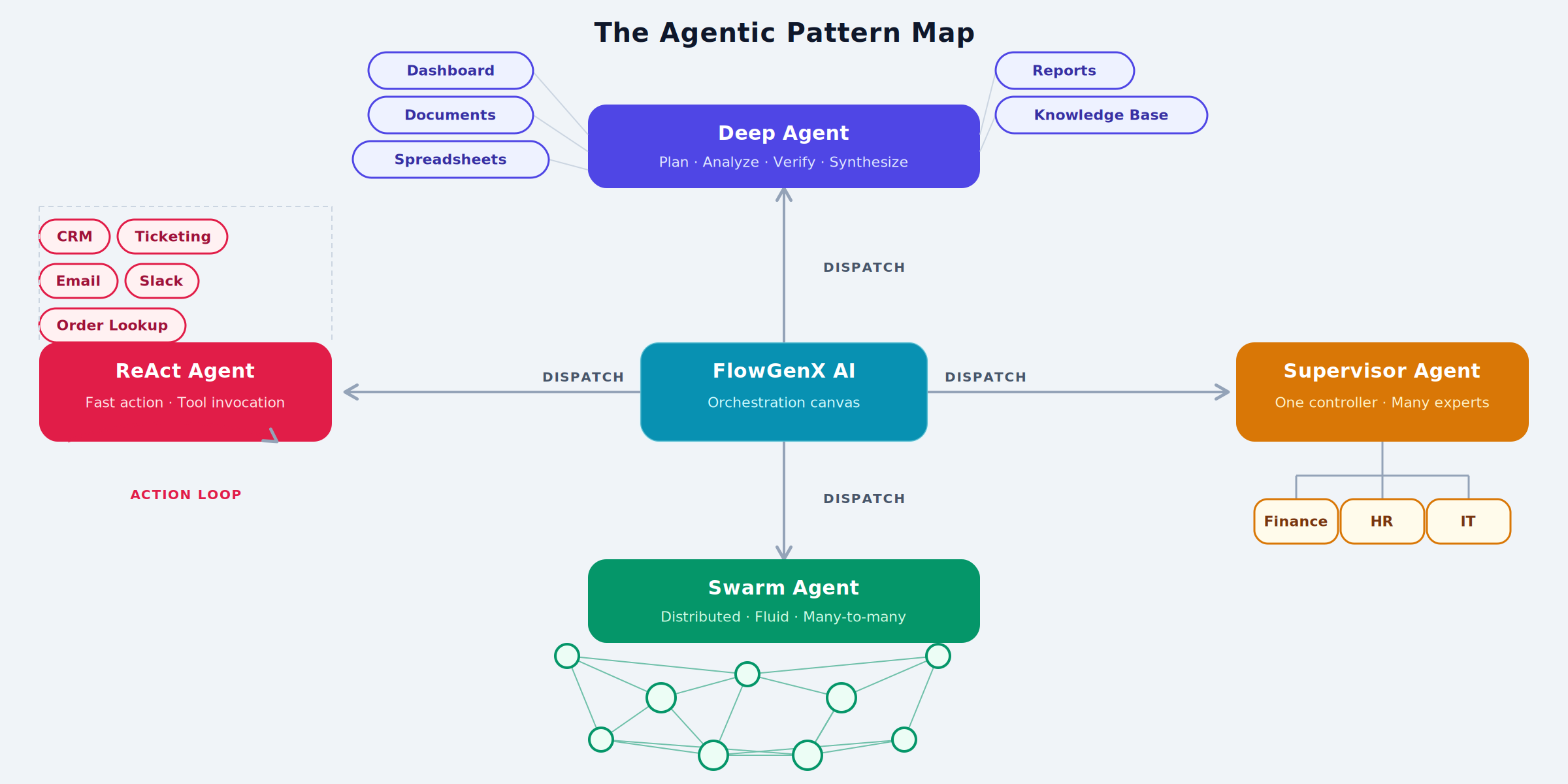
Every business has workflows that eat up hours of human time - not because they're hard, but because they involve juggling multiple systems, making judgment calls, and coordinating across teams. AI agents are changing this. But here's what most people get wrong: there is no single "AI agent" that fits every problem.
An agent that's perfect for answering customer questions will fall apart when you ask it to coordinate a multi-department compliance review. That's why the pattern matters as much as the AI itself.
In this post, we break down four agent patterns, the real business problems each one solves, and why picking the right one can mean the difference between AI that delivers ROI and AI that just burns tokens.
Why One Agent Can't Do Everything
Imagine you run a mid-size e-commerce company. On any given day, your team fields a customer asking "Where's my order?" - a quick, focused lookup. A quarterly financial report that pulls from five systems, cross-references everything, and flags anomalies - careful, structured work. An incoming support ticket that could be billing, shipping, or technical - needs the right specialist, fast. A product launch where marketing, legal, and engineering are passing deliverables back and forth - pure coordination chaos.
One agent structure cannot handle all four well. That's why different patterns exist - and why understanding them is a genuine competitive advantage.
1. ReAct Agent - Your Always-On Specialist
The Business Problem
Your support team answers the same 200 questions every day. Your sales team spends 40% of their time pulling data from CRMs and spreadsheets before they can actually sell. Your ops team manually checks inventory levels across three warehouses every morning.
These are focused, repetitive tasks that follow a natural pattern: look something up, reason about it, take an action.
How It Works
The ReAct agent follows a simple loop - Think, Act, Observe, Repeat - until the job is done. It reasons about what it needs, uses the tools you give it (databases, APIs, Slack, email), checks the result, and decides what to do next.

The loop in action: a customer asks "Where's my order?" The agent thinks, looks up order #4821, sees it shipped and arrives Thursday, and responds with the tracking number. The whole thing takes seconds - no humans involved.
Why This Pattern Delivers Value
Speed to deployment is the biggest advantage. A ReAct agent can be live in hours, not weeks. You define what it knows, what tools it can use, and let it reason through the rest. No complex orchestration, no coordination overhead.
The results are measurable. Teams see up to 70% fewer L1 support tickets once the agent handles routine questions around the clock. Sales reps recover two or more hours a day that used to go toward pulling CRM data and drafting follow-ups. Inventory teams stop missing reorder windows because the agent monitors stock levels and triggers purchase orders automatically.
Where It Shines
It covers repetitive, tool-heavy work that doesn't need a human in the loop. Customer support - order lookups, returns, policy questions. Sales enablement - account summaries, email drafts, follow-up scheduling. Inventory management - stock monitoring, reorder triggers, team alerts. Employee onboarding - HR questions, account provisioning, welcome docs.
In FlowGenX: drop a ReAct Agent node on the canvas, connect your tools, write a prompt. Done. It's the fastest path from "we want AI" to "AI is handling this."
2. Deep Agent - Your Senior Analyst
The Business Problem
Your CFO asks: "Compare our customer acquisition cost across all channels for the last three quarters, factor in the new attribution model, and recommend where to shift budget."
A simple think-act loop won't cut it. This task requires structured planning - break it into steps, pull from multiple sources, cross-reference, validate, and synthesize into a recommendation worth acting on. An agent that rushes in without a plan will miss data, make wrong assumptions, and produce exactly the kind of shallow analysis that erodes trust in AI.
This is the work that takes a senior analyst two days. A Deep Agent does it in minutes.
How It Works
The Deep Agent doesn't jump into action. It plans first - building a structured task list, then executing each step methodically. It can delegate specialized steps to sub-agents, consult reference documents, and verify results before moving on.

Given that CFO request, the agent doesn't start pulling data. It starts by mapping out what it needs to know and in what order - spend data first, then the attribution model, then the calculations that depend on both. Each step informs the next. By the time it delivers the report, every number has been cross-referenced and verified. No gaps, no guesswork.
Why This Pattern Delivers Value
For high-stakes decisions - financial analysis, compliance reviews, strategic planning - you can't afford an agent that wings it. The plan-first approach catches the kind of errors that happen when you jump straight to execution: missing a data source, applying the wrong model, producing numbers that don't reconcile.
The impact shows up in time and quality. Analyst reports that took two days come back in 15 minutes with the same depth. Compliance reviews catch three times more issues because nothing gets skimmed. RFP responses that used to take a week get done in a day - structured, consistent, and actually tailored to the brief.
Where It Shines
Any work where getting it wrong is expensive. Financial analysis that pulls from multiple systems and needs to reconcile. Compliance audits that require checking every requirement against every document, not just the obvious ones. RFP responses where consistency and accuracy across sections directly affect whether you win the deal. Market research that needs a real plan before anyone starts pulling data.
In FlowGenX: configure the Deep Agent node with sub-agents for specialized delegation, and attach context files - policy documents, pricing sheets, historical data - that the agent consults during execution. It's like handing your AI a full briefing before it starts work.
What's Next
ReAct and Deep cover a wide range of real business tasks - from the routine to the analytically complex. But some workflows don't belong to a single specialist, however capable. They require coordination across domains, multiple experts, and work that can't always be pre-planned.
In Part 2, we cover the two patterns built for exactly that: the Supervisor Agent, which manages specialist teams, and the Swarm Agent, which handles fluid cross-functional collaboration where no single coordinator can anticipate every step.

Join the conversation with your LinkedIn or Google account